How Much Does Solar Cost in Canberra? (2026 Guide)
Updated 2 July 2026 · By Michael Dariol, Licensed Electrician
The short answer
For a Canberra home in 2026, a quality solar system lands roughly here: a 6.6–10kW system for a typical single-phase home runs about $5,000–$12,000 installed with an optional small battery, and pays for itself in around 4.5–6 years. A 19.8kW three-phase system with a 13–17kWh battery — the sweet spot for larger homes planning an EV or full electrification — lands around $20,000–$22,000 with a 6.5–7 year payback. Big homes with heavy usage (pool, EVs, heat pumps) run $24,000–$35,000 for 20–25kW with more storage, still paying back in about 6–7 years.
Those are real ranges from our own quoting data, after rebates, including GST. They're indicative — every roof, switchboard and usage pattern moves the number — but if a quote sits far outside them, it's worth asking why.
What actually drives the price
Four things move a solar quote more than anything else: system size (the number of panels and the inverter class), whether your home is single-phase or three-phase, whether a battery is included and how big it is, and how clean the install needs to be. Panel and inverter quality matters too — there's a real difference between a premium tier-1 all-black panel and the cheapest module that meets the standard.
The quiet cost driver nobody mentions is the switchboard. If your board can't safely carry an inverter — or the EV charger you're planning next year — it needs upgrading, and it's far cheaper to do that once, sized for the full picture, than to pay for two separate visits. We assess this on every quote.
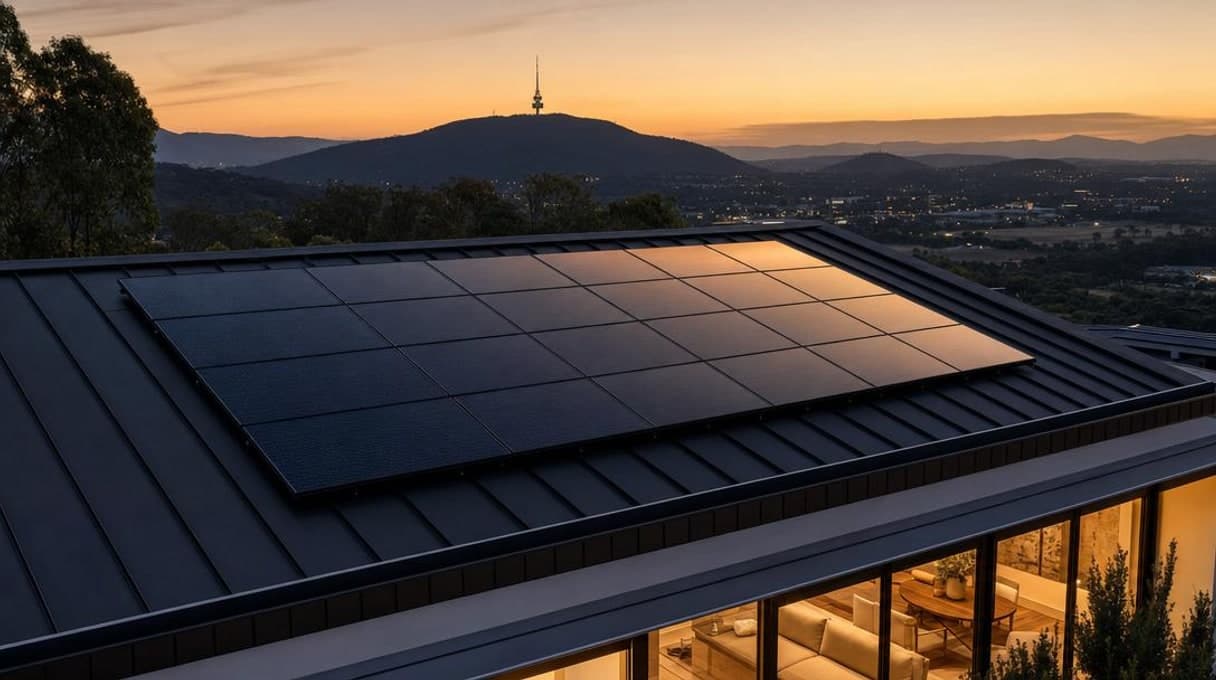
A design-integrated system — flush black-on-black panels, hidden conduit, the array placed to suit the roofline rather than just maximise count — sits above a builder's-special install, because the care and the components are different.
The rebates: what 2026 actually gives you
Three schemes apply to most Canberra homes. Federal STCs (Small-scale Technology Certificates) come off the upfront cost at the point of sale — your installer claims them, so the discount is already on the invoice, and it scales with system size. Worth knowing: the STC deeming period steps down on 1 January 2027, so the same system attracts slightly less rebate next year than it does today.
The 2026 federal Cheaper Home Batteries rebate takes roughly 30% off battery cost, and it also tapers each year through to 2030. And the ACT's Sustainable Household Scheme offers zero-interest loans for solar and batteries, which doesn't cut the sticker price but meaningfully improves the effective payback by spreading the cost interest-free.
There's no separate standalone ACT solar cash rebate beyond these. All of them carry caps and conditions, and the rules change — we confirm exactly what applies to your situation at quote time rather than quoting a figure that's six months stale. You also need an accredited installer to qualify — accreditation is administered by Solar Accreditation Australia, and we confirm the current position for your job at quote time.
Payback: the only number that matters
The sticker price isn't the real cost of solar — the payback is, and it hinges on one thing: how much of your own generation you use. Every kilowatt-hour you consume straight from your panels saves you the full grid rate (around 25c in the ACT). Every kilowatt-hour you export earns the feed-in rate — a few cents. That gap is why two identical systems on two different households can have wildly different paybacks.
It's also why we size systems from your actual bill and usage pattern, not from how many panels fit on the roof. A home that can shift loads to daylight — dishwasher, pool pump, EV charging, hot water — gets to a 5-year payback far more easily than one that uses everything at night. Canberra helps too: cold, clear winter days are genuinely good generating weather, because panels run more efficiently in the cold.
Battery or more panels?
For years our honest answer was that more panels almost always paid back faster than a battery — and for a lot of homes that's still true. But the maths genuinely shifted in 2026: with the federal rebate taking roughly 30% off battery cost and feed-in tariffs falling, storing your own power is worth more than exporting it for a few cents.
The right home for a battery has real evening usage, a low feed-in rate, and plans to stay long term. Without one, most homes self-use only about 30% of what they generate; a battery lifts that to 70–90%. But if your roof still has room and you use most of your power in daylight, more panels can still be the smarter spend. We run your actual numbers and show you both — solar-only and solar-plus-battery, each with its own payback — rather than one blended figure that hides which part is doing the work.
Getting a number for your home
A real solar quote starts with your bill, not your roof. Bring a recent electricity bill (or just your quarterly spend), tell us what's coming — EV, pool, ducted air conditioning, full electrification — and whether your supply is single or three-phase. From that we size the system to your usage, check the switchboard, and give you an itemised price with the rebates already applied and an honest payback for each option.
If you're building new, even better: designing the solar in with the electrical means the conduit is hidden, the board is sized once, and the array is planned with the roofline instead of bolted on after. That's the difference between solar that powers a beautiful home and solar that's just on it.